A majestic pagoda in Tra Vinh province
Phno Don pagoda is also called Gong Lon pagoda or Stork pagoda. It was built in 1677 on the alluvial bank of a big canal in Dai An commune, Tra Cu district, 40 km south of Tra Vinh city.
The pagoda is surrounded by green bamboo groves, several species of evergreen trees, and vast rice fields stretching to the horizon. Flocks of storks come here to shelter.
Trinh Van Minh, a resident of Dai An commune, said, “Storks stay in the land surrounding the pagoda, so people call it Stork pagoda. They come here in the rainy months to nest and breed. This is the largest, most famous, and most beautiful pagoda in Tra Vinh province. It attracts many visitors from across Vietnam and even some foreigners. During the New Year holiday the pagoda is very crowded.”
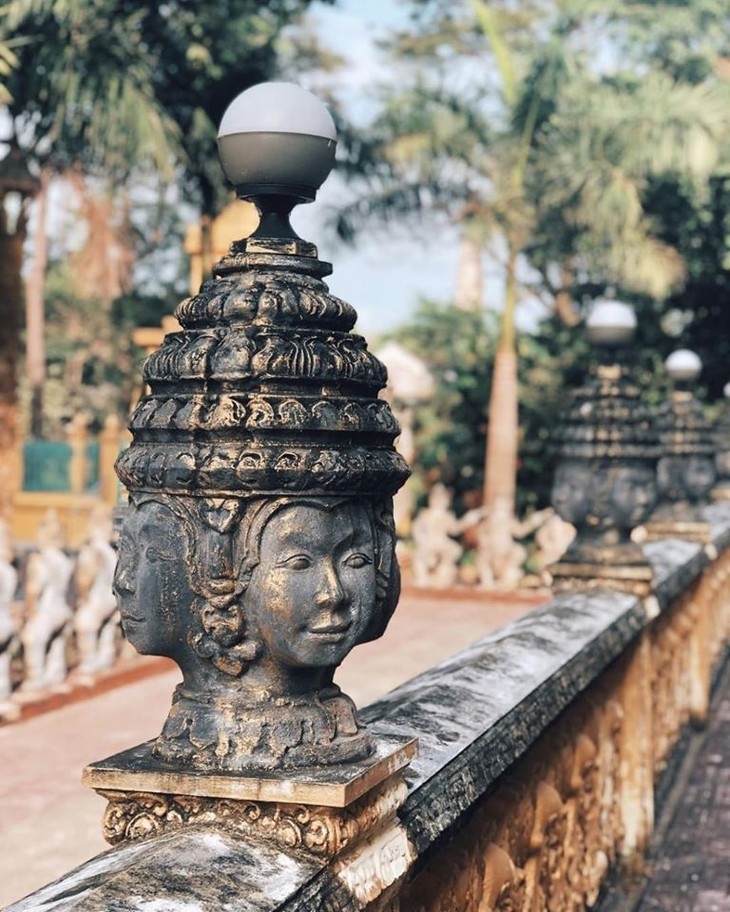
The Khmer architectural style can be seen in the pagoda gate, the main hall, the monks’ house, the main hall, and the towers that hold the ashes of cremated monks.
The external decoration is a harmonious combination of gilded lacquer paint and traditional Khmer patterns.
On the intricately carved main gate four fairies are raising their hands as if to support the roof. There are embossed paintings of lotus flowers and deities on either side.
Tran Keo, Head of the Phno Don pagoda Management Board, said, “The pagoda was built more than 340 years ago. The main hall is approximately 50m high, 60m wide, and 100m long. Outside there are statues of warriors holding weapons to guard the main hall and girls greeting arriving guests.”
“A flagpole in the shape of a bird flies a Buddhist flag on one side and a national flag on the other. The pagoda has been recognized as a provincial relic site. This site has attracted foreign visitors,” he added.
The main hall is decorated with splendid paintings and Buddha statues. The main roof has beautiful curved lines in the shape of a dragon’s tail.
The rooftop towers are shaped like Mount Xome and images familiar to the Khmer, such as the four-faced God Mohabrom, the sacred bird Keynor, Riehu, and Mahaknot.
The spacious main altar has a large statue of a seated Sakyamuni Buddha. Below it are six smaller statues of Buddha in enlightenment and Buddha holding a bowl and begging for alms.
Head monk Truong Van Bien said, “Khmer pagodas often have images of dragons, snakes, and sacred figures, and statues of ogres and demons of the underworld. The 4-faced statue is of Brahma, who reminds parents, kings, and ordinary people to hold on to their virtue, compassion, and equanimity.”
“Khmer people go to pagodas to soothe their souls. On the 1st, 8th, 15th, and 30th day of the lunar month, Buddhist followers visit the pagoda to worship and bring food to the monks. When the pagodas are repaired, people make a voluntary contribution of whatever they can afford,” he noted.
Every Khmer pagoda is a work of art, but only Phno Don pagoda is famous for also sheltering thousands of storks.
The post A majestic pagoda in Tra Vinh province appeared first on Vietexplorer.com.
View more from VietExplorer:
Ugandan dancer brings African cuisine to VietnamMong ethnic minority’s baby naming ritual
A tour around traditional ethnic markets in Dien Bien province
Sin Suoi Ho flea market bustling with ethnic activities
Unique calendar of Thai people
Ba Na people’s year-end Thanksgiving for Gods
Co Tu people’s Thanksgiving for parents
South Koreans travelers eager to re-visit Vietnam
Con Son-Kiep Bac: Land of Vietnam’s revered figures
Exploring Southeast Asia’s longest volcanic cave
Vietnam among top 20 World’s Best Places to Retire in 2022
First-ever pedestrian zone in Can Tho makes debut
Cai Rang – A unique floating market in the Mekong Delta
Hong Chinh fishing village’s tourism potential promoted
Lam Binh district, a site rich in archaeological relics, eco-tourism potential
Lieng Rowoa: a cascade associated with a legend and history
Major man-made lake exudes peaceful charm
Famous tourist spots in localities to host SEA Games 31 competitions
Vietnam honoured at World MICE Awards 2021
World's longest glass bridge set to open to public in Vietnam on April 30


Comments
Post a Comment